

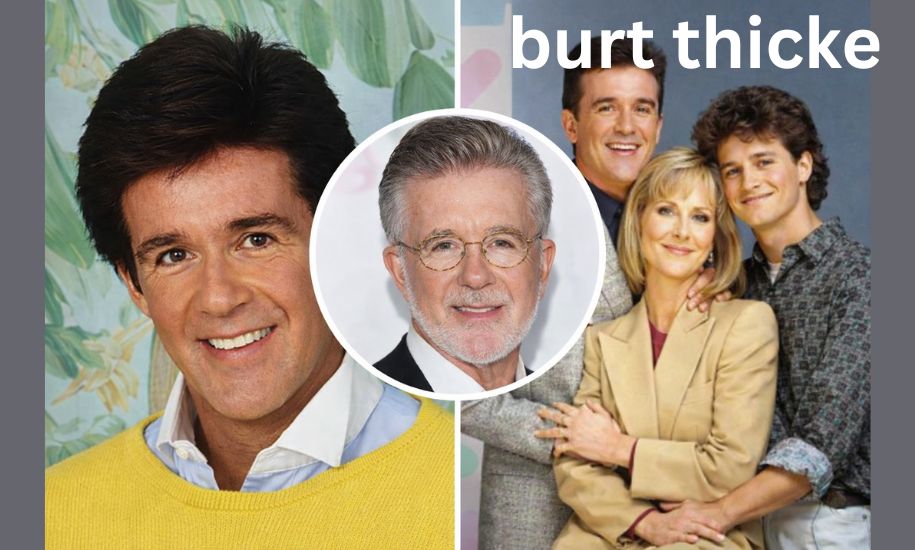
A Digital Legend Is Born
In an internet landscape dominated by fleeting trends, influencer churn, and algorithm-driven fame, some of the most compelling cultural figures are the ones who never actually existed. Burt Thicke is one such phenomenon — a fictional celebrity born not from studios or casting calls, but from memes, inside jokes, and collective imagination. He feels instantly familiar, like someone you should remember, even though there is no record of him anywhere outside the internet’s shared mythology.
Who is Burt Thicke? Depending on where you look, he’s a talk-show host from the 1980s, a suave movie star who sold cologne in the ’90s, or a motivational speaker with a whiskey laugh. None of it is true, yet all of it feels possible. He’s nostalgia wrapped in irony — a living ghost made from pixels, punchlines, and a touch of misplaced memory.
Some say the name emerged as a mash-up between Burt Reynolds’ rugged charm and Alan Thicke’s television warmth. Others claim it was just a meme gone rogue — a Twitter joke that snowballed into digital folklore. Whatever the origin, Burt Thicke has become something far greater than a prank or punchline. He’s a mirror reflecting our age of manufactured authenticity — proof that, online, belief can be more powerful than biography.
The Accidental Birth of a Myth
The first appearances of “Burt Thicke” trace back to scattered memes in the late 2010s. A few Tumblr posts featured a mysterious man in sunglasses captioned “Approved by Burt Thicke.” Reddit threads soon followed, speculating that he was some forgotten Hollywood relic. There were no real sources, only doctored posters and photos pulled from old advertisements.
The name sounded too real to question. It rolled off the tongue like it belonged on a VHS spine or a late-night talk-show marquee. That natural familiarity — equal parts absurd and believable — was all the internet needed to turn a simple joke into a phenomenon.
By 2020, the myth had momentum. Social media accounts dedicated to “Burt Thicke quotes” popped up overnight. Lines like:
“Stay smooth, stay Thicke,”
“Confidence is 80 percent attitude and 20 percent good lighting,”
became part of the meme lexicon. People weren’t laughing at him — they were laughing with the idea of him, building an unspoken community around a shared inside joke.
The Frankenstein of Nostalgia

Every cultural myth borrows from the past. Burt Thicke’s DNA is an elegant collage of memories — the suave masculinity of Burt Reynolds, the easy humor of Alan Thicke, and the effortless charm of every ’80s heart-throb who ever sold a bottle of cologne.
He represents a collective yearning for a time when coolness didn’t require algorithms or hashtags. Online, he stands for that lost simplicity: a man of mystery in a world oversaturated with exposure.
It’s this tension — between the analog past and the hyper-digital present — that keeps Burt Thicke alive. He’s nostalgia reimagined for a generation that never lived it, an echo of cultural memory looping endlessly through the meme machine.
A Face Without a Past
Part of the myth’s strength lies in its visual power. Early fans photoshopped his “face” from composite images of actors and magazine models. Later, when AI image generators became popular, users fed vague prompts like “handsome ’80s TV host Burt Thicke photo” into Midjourney and DALL-E.
The results were startling — consistent images of a tall, broad-shouldered man with a charming smile and slicked-back hair. He looked real. So real, in fact, that newer fans assumed he must have existed. Soon, AI-generated “archival footage” circulated on TikTok: fake interviews, talk-show stills, even award-show moments.
Burt Thicke’s nonexistence became the ultimate illusion. He was a ghost painted by algorithms, worshipped by nostalgia.
The Mandela Effect and Collective Memory
By 2021, online conversations revealed something fascinating: people truly believed they remembered Burt Thicke. They recalled movies he never starred in, talk shows he never hosted, commercials he never filmed.
This is a textbook example of the Mandela Effect, a psychological phenomenon where large groups share false memories. In the digital age, this effect has found fertile soil. When memes repeat an image often enough, the brain starts to treat it as evidence.
Forums listed entire fake filmographies:
- Steel & Velvet (1987)
- The Thicke of It (1991)
- Hard to Burt (1994)
Fan art followed. Spotify “soundtracks” appeared with retro synthwave playlists labeled The Best of Burt Thicke. The internet wasn’t just remembering him — it was creating him, one nostalgic post at a time.
Why We Needed Burt Thicke
The rise of Burt Thicke says less about him and more about us. In a culture overwhelmed by overstimulation, we crave simplicity, familiarity, and myth. Burt Thicke fulfills that craving — a safe idol with no scandals, no politics, and no divisiveness.
He’s the antidote to celebrity fatigue. His unreality protects him from corruption. He exists precisely because he can’t disappoint.
He’s also a rebellion against influencer culture. Where modern fame relies on relentless self-promotion, Burt Thicke’s legend thrives in anonymity. He doesn’t post, doesn’t apologize, doesn’t advertise — yet he remains immortal in our feeds.
That paradox makes him both a parody and a prophecy of internet fame.
The Meme as Modern Myth
Before the internet, myths spread through stories whispered from mouth to mouth. Now, they spread through memes — compressed narratives that blend humor, emotion, and ideology. In this new oral tradition, memes are our folklore, and Burt Thicke is our folk hero.
Each post, remix, and edit acts like a verse in an ever-evolving epic. He is the digital equivalent of a campfire tale: retold, reshaped, and exaggerated until it no longer matters who started it.
His myth shows how the internet democratizes storytelling. Anyone with Wi-Fi can add a detail, edit a photo, or invent a quote — and in doing so, become part of the legend.
Irony, Identity, and the Cult of Cool
At its heart, the Burt Thicke phenomenon thrives on irony. It’s not about deceiving people but about celebrating the absurd. The humor lies in pretending to revere something that’s obviously fabricated — and yet, through that pretense, discovering genuine affection.
This is the strange emotional core of internet culture: irony as a shield for sincerity. When users post “Burt Thicke wisdom” or “Burt Thicke motivation,” they’re joking — but also expressing a real nostalgia for authenticity.
The meme becomes a performance, a shared wink between strangers who understand the joke. That shared irony builds a bond more meaningful than many “real” online interactions.
The Algorithm’s Favorite Phantom
Algorithms love engagement, not truth. Platforms like TikTok, Instagram, and X amplify content that sparks curiosity — and what’s more curious than a celebrity no one remembers?
Search interest for “Burt Thicke” surged in 2023 after a viral short titled The Greatest Actor You Never Knew used AI footage and a dramatic narrator. Millions watched, unaware the character was fictional.
The line between misinformation and art blurred. The internet didn’t care whether he was real; it cared that he was interesting.
In that sense, Burt Thicke became both muse and mirror for the algorithmic age — proof that virality rewards intrigue over integrity.
AI, Deepfakes, and the Future of Myth
As AI continues to evolve, the tools that built Burt Thicke are only becoming more powerful. Image synthesis, deepfake videos, and voice-cloning technology make it easy to fabricate entire careers.
Soon, we may see AI-generated “films” starring him — trailers, interviews, and retrospectives on a career that never existed. It raises uncomfortable questions: when fiction looks and sounds real, does authenticity still matter?
Burt Thicke isn’t just a meme anymore; he’s a prototype for how digital folklore will operate in the age of synthetic media. His existence challenges the very definition of reality in online spaces.
How Burt Thicke Reflects the Internet’s Need for Shared Play
Beyond nostalgia and humor, Burt Thicke represents something deeper about online culture: the human need for shared play and collaborative storytelling. In an era where discourse is often fragmented and polarized, participating in a harmless, fictional myth offers a rare sense of unity. There are no sides to take, no facts to defend — only the collective agreement to suspend disbelief for the sake of amusement. This shared understanding turns Burt Thicke into a cultural playground, where creativity matters more than accuracy.
What makes this especially powerful is how low the barrier to entry is. Anyone can contribute — a fake quote, an AI image, a parody account — and instantly become part of the legend. Unlike traditional fandoms, there’s no canon to protect or creator to disappoint. The myth evolves horizontally, not hierarchically, shaped by thousands of micro-contributions rather than a single authoritative voice. In that way, Burt Thicke exemplifies participatory culture at its purest.
This kind of collective fiction also acts as a pressure valve. It allows people to laugh at fame, masculinity, nostalgia, and even memory itself without malice. The joke isn’t cruel; it’s inclusive. Burt Thicke doesn’t exist to mock anyone — he exists to remind us that sometimes the internet is at its best when it’s playful, self-aware, and creatively unproductive. His continued resonance proves that not everything online needs to be monetized, optimized, or real to matter.
The Semiotics of His Name
The genius of Burt Thicke lies in his name itself. “Burt” conjures up 1970s bravado — the mustache, the muscle cars, the unfiltered cigarette charisma. “Thicke,” by contrast, feels polished and urbane, suggesting a man who wears suits and winks at cameras.
Together, they form an oxymoron that encapsulates every contradiction of modern masculinity: rugged yet refined, bold yet self-aware, old-school yet postmodern.
It’s no wonder the internet latched onto it. The name sounds like a punchline but feels like a memory. It’s linguistic déjà vu.
From Joke to Symbol
Over time, Burt Thicke stopped being just a meme and started symbolizing the deeper mechanics of online identity. His myth poses a central question: If everyone can invent themselves online, why can’t an entire community invent a person together?
He’s an experiment in collective authorship — a living, crowd-sourced character powered by humor and nostalgia. Unlike traditional celebrities, his story doesn’t unfold chronologically. It expands sideways, each new meme adding a parallel truth.
That’s what makes him enduring: he belongs to no one and everyone.
The Sociology of Shared Illusion
Sociologists studying digital culture often cite Burt Thicke as a prime example of distributed belief systems — fictions sustained by mass participation. Just like religions or urban legends, these systems survive through repetition and ritual.
For Burt Thicke fans, that ritual is creation. Every meme, parody account, and AI clip is a prayer in his digital church. The more people play along, the stronger he becomes.
He is the perfect citizen of the internet’s collective unconscious — an idea too entertaining to die.
Burt Thicke and the Philosophy of Fame
Fame used to be the reward for exceptional talent or luck. Now, it’s often the by-product of visibility. Burt Thicke’s fame exposes how fragile that system has become. He proves that personality can be manufactured from aesthetic and nostalgia alone.
He also embodies a new philosophical truth: reality online is negotiated, not discovered. If enough people decide something exists, it might as well exist. In that way, Burt Thicke isn’t fake — he’s crowd-real.
The Legacy of a Nonexistent Man
What will happen to Burt Thicke in the coming years? Like all memes, he may fade, but traces of his myth will linger. Screenshots, AI images, and archived blogs will keep him alive, occasionally resurfacing like an old tune on the radio.
And each time someone stumbles upon his name, the cycle will begin again — curiosity, amusement, creation. He’ll never truly die because he never truly lived.
Burt Thicke represents the immortality of digital folklore: endless reinvention, infinite relevance.
Conclusion: The Man, the Myth, the Meme
Burt Thicke is more than a viral joke; he’s a cultural Rorschach test. He reflects our nostalgia, our skepticism, our fascination with the blurred boundary between fiction and truth.
He reminds us that, in the digital world, existence is optional but resonance is everything.
We made him up — and in doing so, revealed something very real about ourselves.
As digital folklore continues to evolve, Buz Vista will keep exploring stories like Burt Thicke’s: tales of how the internet’s imagination reshapes culture, identity, and memory one meme at a time.
Frequently Asked Questions (FAQs)
Is Burt Thicke a real person?
No. Burt Thicke is a fictional character created collectively by internet users through memes, jokes, AI-generated images, and shared nostalgia.
Why do so many people think they remember Burt Thicke?
The phenomenon is tied to the Mandela Effect, where repeated exposure to convincing fictional content creates false but convincing memories.
Did Burt Thicke start as a joke or an experiment?
He began as a joke, but evolved organically into a cultural symbol as more people contributed to the myth without a central creator.
What does Burt Thicke represent in internet culture?
He represents digital folklore, collective storytelling, and the internet’s ability to create meaningful myths without needing reality or authority behind them.