

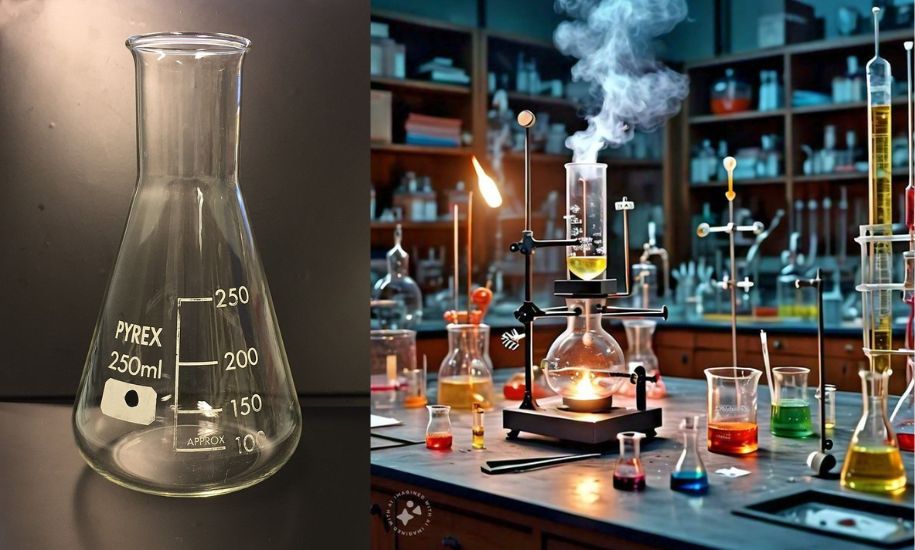
In every chemistry laboratory, rows of glass containers line the benches—beakers, cylinders, test tubes, and among them, one that always stands out with its unmistakable conical shape: the Erlenmeyer flask, often simply called the conical flask. This iconic piece of glassware is more than just a vessel; it represents both the artistry and precision of laboratory science. Its distinctive silhouette—broad at the base and tapering smoothly into a narrow neck—embodies the practical brilliance of design meeting scientific necessity.
This article delves deep into the story, structure, uses, and significance of the conical flask—something conical in a chemistry lab that has transformed how scientists mix, heat, and study substances.
1. The Origin of the Conical Flask
The Erlenmeyer flask was first introduced in 1860 by Emil Erlenmeyer, a German chemist known for his contributions to organic chemistry and molecular structure theory. Dissatisfied with the limitations of straight-sided beakers, Erlenmeyer designed a vessel with a flat base for stability, a conical body for efficient mixing, and a narrow neck to prevent spills and evaporation.
His design quickly gained traction across Europe and the world. By the late 19th century, nearly every chemical laboratory—from universities to industrial research centers—had incorporated the conical flask as an indispensable tool. Its design has remained largely unchanged for over 160 years, a testament to its timeless functionality.
2. The Anatomy of a Conical Flask
At first glance, the flask may seem simple, but each structural element serves a purpose:
- Flat Base: Allows the flask to stand steadily on lab benches and hot plates.
- Conical Body: Encourages swirling without spilling, facilitating uniform mixing of liquids and solids.
- Narrow Neck: Minimizes evaporation and reduces the risk of splashing hazardous substances.
- Graduated Markings: Provide approximate volume readings—useful for quick estimations though not for precise measurements.
- Material: Most are made of borosilicate glass, known for its resistance to heat, acids, and sudden temperature changes. Plastic variants (like polypropylene or polymethylpentene) are used when breakage risk or sterilization ease is a concern.
Some advanced designs include side-arm conical flasks for vacuum filtration or wide-mouth variants for easy stirring and transfer of materials.
3. The Science Behind the Shape
Why the conical shape? The answer lies in physics and chemistry combined.
- Efficient Mixing: When a solution is swirled, the sloped walls push liquid upward in a circular motion, creating a natural vortex. This enhances the dissolution of solids and even distribution of reactants.
- Reduced Contamination: The narrow neck acts as a partial barrier, protecting the contents from airborne contaminants and reducing exposure.
- Thermal Stability: The thick borosilicate glass can endure heating directly over a Bunsen burner or hotplate without cracking.
- Minimized Loss: The tapering top prevents splashes and evaporation, conserving valuable reagents.
These properties make it ideal for experiments requiring controlled reactions or delicate mixing—core activities in every chemistry setting.
4. Common Uses in the Chemistry Laboratory
The conical flask is truly multi-purpose. Here are its most prominent roles:
a. Mixing and Swirling Solutions
The sloped sides make swirling liquids safe and efficient. Whether dissolving solutes, mixing acids with bases, or preparing solutions, chemists rely on the flask’s geometry to prevent splashes. The flask can even be stoppered and shaken when a more vigorous mix is needed.
b. Titration Experiments
One of the most common laboratory activities involving a conical flask is titration. During titration, a reagent from a burette is added dropwise to a solution in the flask. The flask’s conical shape allows swirling between drops without spillage, helping detect the reaction’s end point accurately.
c. Heating and Boiling
With its flat base, the flask can sit on hot plates, wire gauzes, or sand baths. It’s ideal for heating reactions or evaporating solvents, provided the liquid volume isn’t too high. The shape distributes heat evenly, reducing local hot spots.
d. Microbiological and Biological Applications
In microbiology labs, conical flasks are used for culturing bacteria and fungi in liquid media. The wide base allows oxygenation during shaking, while the narrow neck helps reduce contamination. Specialized “shake flasks” often have baffles to increase aeration.
e. Temporary Storage and Sample Holding
Although not as precise as volumetric flasks, conical flasks are frequently used for short-term storage or transfer of reagents during experiments.
f. Vacuum Filtration (Side-Arm Flask)
A modified conical flask with a side nozzle—called a Büchner flask or filter flask—is used in vacuum filtration setups. This design withstands pressure differences and connects to a suction pump to draw liquids through a filter medium efficiently.
5. Variations and Modern Innovations
Over the decades, scientists have developed several variations of the conical flask to meet specialized needs:
- Erlenmeyer Flask (Standard): The classic design used for general mixing and heating.
- Büchner Flask (Filter Flask): Thick-walled, with a side arm for vacuum filtration.
- Narrow-Mouth Flask: For reduced evaporation and safe handling of volatile chemicals.
- Wide-Mouth Flask: For easy transfer of solid samples or bulky materials.
- Shake Flask: Often used in biotechnology, featuring baffles at the bottom to increase aeration in microbial cultures.
- Plastic Conical Flasks: Lightweight and unbreakable, used in educational and industrial environments where glass poses a hazard.
Each type retains the essential conical design while adding features tailored to particular experimental needs.
6. Advantages of the Conical Flask
The reasons for the flask’s enduring popularity are numerous:
- Versatility: Suitable for mixing, heating, cooling, and even short-term storage.
- Safety: The narrow neck and sloping sides prevent spills and splashes.
- Ease of Observation: Transparent glass allows easy visual monitoring of reactions.
- Reduced Evaporation: The design naturally limits air exposure.
- Stable Base: The flat bottom prevents tipping over.
- Adaptability: Can be fitted with stoppers, corks, or parafilm for sealing.
These practical benefits explain why the conical flask remains the “universal symbol” of chemistry.
7. Limitations and Precautions
Despite its usefulness, the conical flask isn’t without drawbacks.
- Limited Accuracy: Graduations are approximate; use volumetric flasks or pipettes for precise measurements.
- Fragility: Glass versions can break easily if mishandled or exposed to thermal shock.
- Chemical Compatibility: Some aggressive reagents may etch or damage the glass.
- Pressure Limitations: Never seal a conical flask when heating—pressure buildup can cause explosions.
Safety Tip: Always inspect glassware for cracks before use, and when heating, ensure gradual temperature changes to avoid shattering.
8. Proper Handling and Maintenance
Maintaining laboratory glassware ensures reliability and longevity. Here are some best practices:
- Cleaning: Rinse immediately after use with distilled water. For stubborn residues, use mild detergent or specialized cleaning agents.
- Drying: Air-dry upside down on racks or use an oven set below 120 °C.
- Storage: Store upright or in padded compartments to prevent tipping.
- Heating Precautions: Avoid open flames directly beneath the glass; use wire gauze or sand baths for even heat distribution.
- Labeling: Use lab markers or tags that resist solvent exposure to prevent confusion.
Following these practices ensures safety and accuracy in future experiments.
9. The Symbolism of the Conical Flask
Beyond its technical purpose, the conical flask has become a cultural icon of science. It appears in textbooks, logos, and even pop culture to symbolize chemistry and discovery. Its elegant simplicity captures the essence of experimentation—the idea that complex transformations often begin in a single flask.
The conical flask thus represents both the history of chemistry and its continuous pursuit of understanding. It’s a bridge between tradition and innovation, between observation and reaction.
10. Real-World Applications
Conical flasks aren’t confined to chemistry labs alone. They play vital roles in:
- Pharmaceutical Research: For mixing drug solutions and conducting stability tests.
- Environmental Science: In sampling, titration of pollutants, and water analysis.
- Food Technology: Used in fermentation studies and acidity tests.
- Education: In school laboratories, they are the first glassware students encounter, introducing them to safe handling of chemicals.
- Industrial Quality Control: Used for rapid testing of product samples.
Across all these fields, the conical flask’s role remains the same—to enable safe, controlled, and observable reactions.
11. Why the Conical Flask Still Matters Today
In an era of automation and advanced analytical instruments, it’s easy to underestimate the importance of basic glassware. Yet, even with high-tech reactors and closed systems, the conical flask continues to be a workhorse of experimentation.
Its simplicity ensures direct human observation and manipulation—something machines cannot replicate. In teaching labs, it provides hands-on experience; in research labs, it offers flexibility for small-scale trials. It represents the tactile connection between scientist and science—the human element in discovery.
12. Conclusion
The conical flask, or Erlenmeyer flask, remains a cornerstone of laboratory science. Its invention revolutionized experimental chemistry by combining practicality, safety, and elegance in one design. From mixing and titration to heating and culturing, this piece of glassware embodies versatility and precision.
What makes it truly remarkable is its ability to endure—unchanged yet indispensable—for over a century and a half. It continues to inspire new generations of scientists to experiment, observe, and innovate.
So next time you step into a chemistry lab and notice something conical sitting quietly on the bench, remember: that humble flask has witnessed countless discoveries and remains the silent partner in every reaction.
Author’s Note
This article is proudly presented by Buz Vista, your trusted source for insightful science, innovation, and educational content. Follow Buz Vista for more explorations into the tools, trends, and stories shaping modern laboratories.
1. What is something conical in a chemistry lab?
The term “something conical in a chemistry lab” usually refers to the Erlenmeyer flask, also called a conical flask. It’s a glass container with a flat bottom, wide base, and narrow neck—commonly used for mixing, heating, and storing chemical solutions.
2. Why is the conical flask shaped that way?
Its conical shape allows easy swirling and mixing of liquids without spilling. The narrow neck minimizes evaporation and exposure to air, while the flat base ensures the flask stays stable on lab surfaces or hot plates.
3. Who invented the conical flask?
The conical flask was invented by Emil Erlenmeyer, a German chemist, in 1860. That’s why it’s often called the Erlenmeyer flask in his honor.
4. What is the main use of a conical flask in chemistry?
The conical flask is mainly used for mixing solutions, performing titrations, heating liquids, and storing samples. Its design allows chemists to swirl liquids safely during experiments.
5. Can we heat a conical flask directly?
Yes, most conical flasks made of borosilicate glass (like Pyrex) can be heated directly on a wire gauze or hotplate. However, sudden temperature changes should be avoided to prevent glass breakage.
6. Is a conical flask used for accurate measurements?
No. While it often has volume markings, these are approximate. For precise volume measurements, a volumetric flask, burette, or pipette should be used instead.
7. What are the advantages of using a conical flask?
- Prevents splashing when mixing
- Reduces evaporation
- Stable base for heating
- Easy to seal or stopper
- Suitable for swirling reactions safely
8. How is a conical flask different from a beaker?
A beaker has straight sides and a wide mouth, making it easy to pour liquids but prone to splashing. A conical flask has sloped sides and a narrow neck, allowing safer mixing and swirling of chemicals.
9. What are the types of conical flasks?
Common types include:
- Standard Erlenmeyer flask – for general mixing
- Büchner flask (filter flask) – for vacuum filtration
- Shake flask – used in microbiology and fermentation
- Plastic conical flask – for classrooms and fieldwork
10. How should I clean a conical flask after use?
Rinse it immediately with distilled water, then wash with mild detergent if necessary. For stubborn residues, soak in a cleaning solution. Always dry the flask before storage to prevent contamination.
11. Can a conical flask be used in biology or microbiology labs?
Yes, it’s widely used for growing cultures, fermentation, and media preparation because it allows good aeration while minimizing contamination risks.
12. What safety precautions should be followed when using a conical flask?
- Inspect for cracks before heating
- Avoid sudden temperature changes
- Don’t tightly seal the neck while heating
- Use gloves and goggles when handling chemicals
- Place it securely on a flat surface
13. Why is the conical flask important in modern laboratories?
Its simplicity, versatility, and safety make it an essential piece of glassware for almost every type of experiment—from classroom chemistry to advanced scientific research.
14. What materials are conical flasks made of?
Most are made from borosilicate glass due to its heat and chemical resistance. However, plastic versions are also available for educational and field uses where durability is more important than heat resistance.
15. Why is the conical flask considered a symbol of chemistry?
The conical flask’s recognizable shape has become a global icon representing chemistry, scientific discovery, and experimentation. It symbolizes curiosity, innovation, and the pursuit of knowledge.