

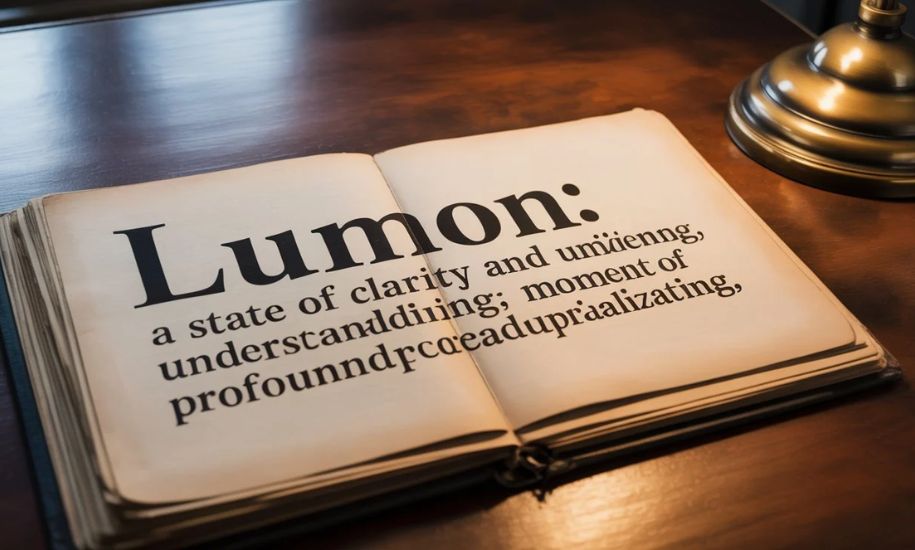
In an age when new words rise from online subcultures, television screens, corporate branding, and the unpredictable churn of virality, few terms have traveled as strangely—or as swiftly—as “Lumon.” It is a word that technically doesn’t exist within the boundaries of the English dictionary, yet its cultural footprint is large enough to spark debates, Reddit theories, industry confusion, linguistic curiosity, and a new wave of symbolic interpretation.
To define Lumon, one must begin with a contradiction: the word has no single definition, and that is precisely why so many people are searching for it.
A Name Searching for a Meaning
Unlike traditional vocabulary, which passes down through etymological bloodlines, Lumon appears to have been assembled—carefully, intentionally, or accidentally—by creators, marketers, writers, and audiences over the past few decades. Today, if you type “lumon definition” into a search engine, you’ll encounter three dominant realms where the word has found a home:
- Corporate branding in the real world
- Fictional world-building in pop culture
- Symbolic and metaphorical usage online
Together, these three branches explain why readers, linguists, marketers, and media obsessives have been trying to pin down the term. The search for “lumon definition” isn’t about decoding a word—it’s about tracing its echoes through modern culture.
The Latin Light at the Center of Lumon
While Lumon has no formal presence in English, many scholars and language observers believe its core resonance stems from the Latin word “lumen,” meaning light, brightness, or an opening through which light passes. Linguistically, this root has influenced common English words including illuminate, luminary, luminosity, luminous, and even units of brightness like lumens.
So even though Lumon is not directly derived from classical Latin, the connection is intuitive. “Lumon,” by structure and sound alone, radiates with soft vowels and the lum- prefix—evoking illumination, clarity, transparency, and revelation.
And in a twist of irony, many modern uses of Lumon turn that symbolism on its head.
Lumon in the Real World: A Company of Glass and Transparency

Long before prestige television would twist the name into a symbol of corporate secrecy, there was Lumon, a Finnish family-owned company specializing in balcony glazing, architectural glass, and outdoor-indoor living spaces. For more than four decades, the company has built a global identity around openness—literally.
Lumon’s products are about:
- letting in light
- creating transparent spaces
- expanding homes outward
- dissolving the boundary between interior and exterior life
It’s a fitting marriage of brand and meaning. A word that hints at brightness and clarity is attached to a company that deals in exactly that.
Yet even this real-world branding was not immune to cultural collision. In 2022, when a certain Apple TV+ series gained traction, Lumon suddenly found itself fielding unexpected questions from strangers online:
“Are your employees severed?”
“Is this the real Lumon Industries?”
“Is this where they do the mind-splitting surgery?”
For a glazing company accustomed to discussing balcony enclosures, this was—as one executive remarked—“a surreal month.”
And it brings us to the second realm of the word’s ascent.
Lumon Industries: The Fictional Monolith That Rewired the Word
The television series Severance presented viewers with a chilling premise: a corporation that surgically divides the human consciousness into two separate identities—one that exists only at work, and one that exists outside of it. The company behind this operation?
Lumon Industries.
From the moment the series premiered, the name became synonymous with:
- corporate surveillance
- manipulation and psychological control
- cult-like rituals and slogans
- sterile hallways and secretive departments
- the uncanny divide between work-self and life-self
This fictional Lumon, unlike its real-world namesake, embraced darkness—not light. Its logo, uniforms, departments, and internal vocabulary became a cultural phenomenon. Viewers probed every corner of its mythos, picking apart clues hidden in the architecture, the promotional posters, the dialogue, the company handbook.
Online theorists offered dozens of interpretations of the name:
- Lumon is derived from lumen, hinting at the idea of enlightenment turned inside out.
- Lumon represents “light” that blinds rather than reveals.
- The name’s softness is a deliberate contrast to the company’s cold, authoritarian structure.
- It’s an example of corporate branding designed to sound friendly and futuristic while masking something sinister.
Perhaps the most interesting theory—one frequently mentioned on Reddit—is that Lumon, like lumen, refers to the inner hollow space of a biological structure. In science, a “lumen” is the inside of a tube, vessel, or cell. Fans have wondered if the show consciously borrowed this scientific term to allude to the hollowed-out identity of severed workers.
Whether intentional or not, Lumon Industries transformed the word’s cultural meaning. Today, if you reference “Lumon” to a television fan, they won’t think of balconies—they’ll think of brain surgery.
A Word Shaped by Duality
The power of Lumon lies in its paradoxes.
In the real world, it evokes light.
In fiction, it represents darkness.
In branding, it feels clean and minimalistic.
In pop culture, it suggests secrecy and psychological manipulation.
This duality gives “lumon” an unusual elasticity. It can serve as:
- a corporation’s name
- a symbol of enlightenment
- a metaphor for identity
- a fan-theory talking point
- a term used poetically or aesthetically
- a marketing tool
- a catchword for modern dystopian anxieties
The tension between “light” and “shadow” gives the term an almost mythic quality—one that continues to evolve.
The Rising Online Meaning: Sleek, Futuristic, Enigmatic

In the age of digital aesthetics, many once-niche words take on second lives through internet culture. “Lumon” is no exception.
Across blogs, design communities, and branding forums, the word is now used descriptively, even metaphorically:
- “A lumon-style workspace” (meaning modern, minimal, futuristic)
- “The app has a lumon feel” (meaning sleek or mysterious)
- “A lumon moment” (meaning clarity or realization with dramatic flair)
Creators sometimes adopt “Lumon” as a username, brand name, or product tag because it feels:
- modern
- short
- memorable
- clean
- vaguely sci-fi
- subtly poetic
The absence of a fixed dictionary definition has turned Lumon into a versatile aesthetic term—one that users can shape to their own meaning.
A Word That Reveals More About Us Than About Language
Why does a nonexistent word attract so much attention?
Part of the answer lies in how we interpret meaning today. In a world where:
- entertainment shapes our vocabulary
- brands blend into fiction
- fiction bleeds back into real life
- language morphs in online communities
- new words emerge daily without official sanction
Words like Lumon become mini cultural artifacts. They reveal how much we’re influenced not by etymology, but by imagery, emotion, story, and zeitgeist.
The search for “lumon definition” is ultimately a search for clarity in a time when meaning itself feels fluid. People want to know whether Lumon is real, fictional, symbolic, linguistic, corporate, dystopian, aesthetic—or all of the above.
The answer, fittingly, is that it is everything at once.
The Most Accurate Modern Definition
If one were forced to compress the word into a single definition—one broad enough to capture its evolving cultural footprint—it might look like this:
Lumon is a contemporary constructed term associated with light, transparency, and modern design, but widely shaped by its portrayal as a powerful, secretive corporation in pop culture. Its meaning shifts across branding, fiction, and online usage, making it a symbol of both illumination and mystery.
That definition carries the contradiction at the heart of the word. Lumon shines, but it also obscures.
Why the Word Will Likely Keep Evolving
Few words live such double lives. Fewer still pivot from architecture to dystopia to internet slang with such agility. But “lumon” is still young. There is no telling what it may come to mean in ten years—especially as:
- new seasons of streaming shows reinterpret it
- designers adopt it
- branding agencies recycle it
- poets and bloggers reshape it
- meme culture mutates it
- digital aesthetics continue to favor minimal, light-related vocabulary
Language expands by accident as much as by rule. Words like Lumon thrive in that uncertainty
A Future Built on Light and Shadow
If we zoom out, Lumon tells a story about our era—a time when meaning is fragmented, identity is split between the physical and the digital, and corporations loom large in our imaginations. It is no coincidence that the most iconic use of the word involves splitting a human mind in two.
In many ways, the search for the “lumon definition” reflects the search for stability in an increasingly flexible world.
Is Lumon about transparency?
Is it about secrecy?
Is it about illumination?
Is it about control?
The truth is that Lumon sits at the intersection of all these ideas—and that is why the word endures.
Conclusion
“Lumon” may not appear in English dictionaries, but it occupies a vivid place in modern culture. It is a word of light, glass, secrecy, fiction, futurism, aesthetic minimalism, and corporate myth. More importantly, it is a word still in motion—growing, expanding, and redefining itself with every pop-culture moment and branding shift.
And as long as people keep searching for its meaning, Lumon will continue to shine—brightly, mysteriously, and unpredictably.
This article was prepared exclusively for Buz Vista, where we explore the stories behind the words shaping our world.
FAQs on “Lumon Definition”
1. What does “Lumon” mean?
Lumon has no official dictionary definition, but it is commonly associated with light, illumination, clarity, and modern design—largely due to its similarity to the Latin word lumen. Its meaning today is shaped by branding and pop-culture usage.
2. Is “Lumon” a real English word?
No. Lumon isn’t recognized as a standard English word. It is a constructed or brand-associated term whose meaning depends on context.
3. Why is “Lumon” linked to light?
The “lum-” prefix resembles Latin lumen, meaning “light” or “brightness.” Many brands and writers use Lumon to evoke themes of clarity, openness, or illumination.
4. What is Lumon Industries?
Lumon Industries is a fictional corporation in the TV series Severance. It is known for its secretive culture and the controversial “severance” procedure that splits an employee’s memory into work and personal identities.
5. Is there a real company called Lumon?
Yes. Lumon, based in Finland, is a real company specializing in glass balcony enclosures and outdoor living solutions. It is unrelated to the fictional company in Severance.
6. Why are people searching for the lumon definition?
Search interest spiked due to the popularity of Severance and growing curiosity about the symbolic or etymological meaning behind the word. Many also encounter the term through branding and design contexts.
7. Is “Lumon” used in everyday language?
Not in formal language. However, it is sometimes used informally online to describe futuristic, clean, minimalist, or mysterious design aesthetics inspired by the show or brand.
8. What’s the deeper symbolism behind “Lumon”?
Depending on context, the term can symbolize illumination, corporate control, secrecy, modernity, or the duality between transparency and obscurity.
9. Can “Lumon” be used as a brand or project name?
Yes. Because the word is short, modern, and evocative, many creators, startups, and designers use Lumon (or variations of it) for branding or creative projects.
10. Why doesn’t Lumon have a fixed definition?
Because the word emerged from branding and fiction—not traditional linguistics—it evolved through cultural use rather than formal language rules. Its meaning adapts to the context in which it’s used.