

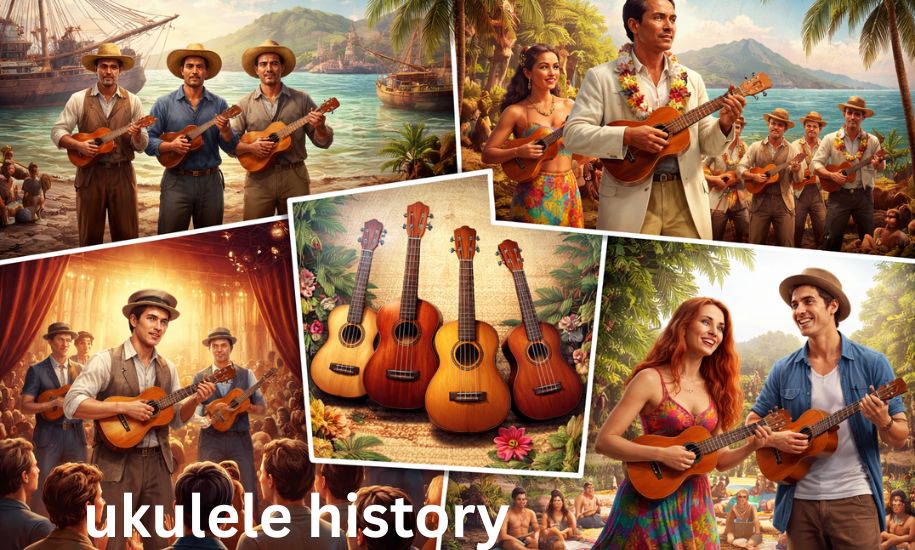
When people think about ukulele history, they often picture beaches, warm breezes, and relaxed island music. That image is not wrong—but it’s only part of the story. The ukulele didn’t suddenly appear fully formed. Its journey began through migration, craftsmanship, and cultural exchange, long before it became a global symbol of joy and simplicity.
The earliest chapter starts in Portugal, particularly on the island of Madeira. In the 19th century, Portuguese immigrants traveled across oceans in search of work and opportunity. Many of them were skilled woodworkers and musicians, carrying with them small stringed instruments such as the machete and the braguinha. These instruments were compact, bright-sounding, and well suited for travel—qualities that would later define the ukulele itself.
When Portuguese immigrants arrived in Hawaii in the late 1800s, their music quickly caught local attention. The sound was lively, rhythmic, and different from anything commonly heard in the islands at the time. Local musicians, already deeply connected to song and storytelling, began experimenting with these instruments rather than copying them exactly. Over time, changes in size, tuning, and construction gave birth to something new.
That “something new” was the ukulele.
The name itself is often translated as “jumping flea,” a playful phrase believed to describe the fast finger movements of players. Whether or not that translation is exact, it captures the spirit of the instrument perfectly. The ukulele was light, expressive, and approachable—qualities that made it easy to embrace across cultures.
Unlike many musical instruments tied closely to formal training or elite settings, the ukulele was immediately social. It fit naturally into gatherings, celebrations, and everyday life. This early accessibility helped it spread quickly throughout the islands, becoming woven into local traditions rather than remaining a novelty from abroad.
From the very beginning, ukulele history has been about adaptation rather than invention. It reflects how cultures borrow, reshape, and create together—often without rigid boundaries or grand plans. That foundation helps explain why the instrument still feels welcoming today, even to people picking it up for the first time.
Hawaiian Identity and Cultural Growth of the Ukulele
As the ukulele took root in Hawaii, it became more than just a musical instrument. It evolved into a cultural voice. Local builders began crafting ukuleles from native woods, especially koa, which added warmth and depth to the sound. These locally made instruments didn’t just look different—they felt different, too, carrying the character of the land itself.
Music in Hawaii has always been closely tied to storytelling, dance, and shared experience. The ukulele fit seamlessly into that tradition. It supported vocal melodies rather than overpowering them, making it ideal for accompanying songs that carried meaning across generations. Over time, the instrument became a familiar presence at community events, family gatherings, and celebrations both large and small.
One important factor in the ukulele’s growth was its acceptance across social boundaries. Unlike instruments that require orchestras or formal venues, the ukulele belonged everywhere. A beginner could strum basic chords and participate almost immediately. That sense of inclusion helped cement its place in everyday life.
The late 19th and early 20th centuries were a time of cultural change in Hawaii, with outside influences arriving rapidly. During this period, the ukulele became a quiet symbol of continuity. While styles evolved and new sounds entered the islands, the ukulele remained rooted in local expression. It adapted without losing its identity.
This balance—between tradition and flexibility—is one of the most important themes in ukulele history. The instrument didn’t resist change, nor did it disappear under pressure. Instead, it absorbed new influences while keeping its core character intact.
As Hawaiian music began reaching audiences beyond the islands, the ukulele traveled with it. Performances at international exhibitions and tours introduced listeners elsewhere to its distinctive sound. For many people, this was their first exposure not just to the instrument, but to Hawaiian musical styles as a whole.
At this stage, the ukulele was still closely associated with Hawaii, and that connection remains strong today. Yet this period also marked the beginning of its transformation into a global instrument—one that could adapt to many musical languages without losing its personality.
For readers of Buz Vista, this phase of ukulele history highlights an important idea: cultural influence doesn’t always move in straight lines. Sometimes it spreads quietly, carried by sound, craftsmanship, and shared enjoyment rather than formal promotion.
The Ukulele’s Global Journey and Shifting Popularity

As the 20th century progressed, the ukulele’s reach expanded far beyond the Pacific. Once introduced to the mainland United States, it quickly found a place in popular entertainment. Its cheerful tone suited early recordings, stage performances, and group sing-alongs, especially during periods when audiences sought lighthearted distractions.
During the 1920s and 1930s, the ukulele experienced a major surge in popularity. It appeared in theaters, radio programs, and casual home music-making. The instrument’s small size made it affordable and practical at a time when many households wanted music without the cost or space demands of a piano.
However, ukulele history is not a straight line of constant success. Like many cultural trends, its popularity moved in cycles. As musical tastes shifted and louder, more complex instruments took center stage, the ukulele faded from the spotlight in some regions. This decline was not a disappearance—it was more like a pause.
Interestingly, the ukulele never fully left. It remained present in certain styles, communities, and regions, quietly passing from one generation to the next. This kind of persistence matters. Instruments that vanish completely rarely return, but those that stay in circulation—even on a small scale—retain the potential for revival.
That revival began gradually in the late 20th century and accelerated in the early 21st. Several factors contributed:
- A renewed interest in acoustic and stripped-down music
- The rise of casual, self-taught musicians
- Easier access to learning through digital platforms
- A growing appreciation for instruments that feel personal rather than technical
The ukulele benefited from all of these trends. It offered a low barrier to entry while still allowing room for creativity and growth. Beginners could enjoy it quickly, while experienced musicians found new ways to push its limits.
What makes this phase especially interesting is how the ukulele shed some of its earlier stereotypes. Once seen mainly as a novelty or a beginner’s toy, it gained respect as a serious instrument capable of nuance and emotional range. Modern players explored fingerstyle techniques, alternate tunings, and genre-crossing arrangements that expanded public perception.
In this way, ukulele history mirrors broader patterns in culture. Things once dismissed as simple or old-fashioned often return with new meaning when viewed through a fresh lens. The ukulele didn’t change its essence—it changed how people listened.
Why the Ukulele Still Matters Today
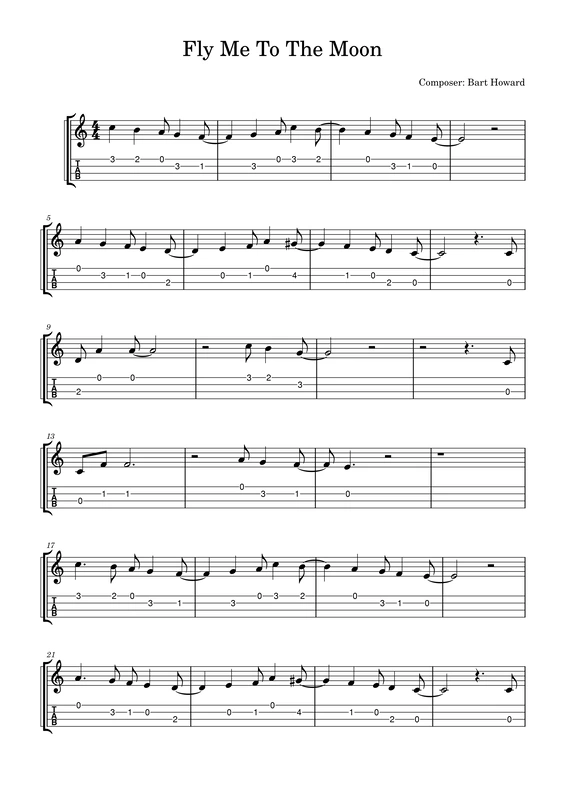

Today, the ukulele occupies a unique space in the musical world. It sits comfortably between tradition and experimentation, simplicity and sophistication. That balance helps explain why interest in ukulele history continues to grow rather than fade.
One reason the ukulele remains relevant is its adaptability. It works across genres—from folk-inspired melodies to modern pop interpretations—without demanding rigid rules. This flexibility allows musicians to bring their own identity into the sound, rather than conforming to a fixed style.
Another reason is emotional accessibility. The ukulele doesn’t intimidate. Its size, tone, and visual appearance all suggest approachability. For many people, it becomes a first instrument not because it is “easy,” but because it feels inviting. That emotional connection often leads to deeper musical exploration later on.
From a cultural perspective, the ukulele also serves as a reminder of how creativity travels. Its story includes migration, adaptation, commercialization, decline, and renewal. These themes are not unique to music—they reflect broader human patterns. Seeing them play out through a single instrument makes them easier to grasp.
It’s worth noting that the ukulele’s modern presence doesn’t erase its past. Hawaiian traditions remain central to its identity, and responsible musicians often acknowledge those roots. Respecting that history adds depth to modern use rather than limiting it.
For platforms like Buz Vista, the ukulele offers a compelling example of how something modest can have lasting impact. It challenges the idea that cultural influence must be loud or complex to endure. Sometimes, longevity comes from being useful, adaptable, and emotionally resonant.
Looking ahead, there’s no clear “final chapter” in ukulele history—and that’s a good thing. Instruments that continue to evolve stay alive. As new players discover the ukulele, they add their own interpretations, shaping how it will be heard in the future.
A Gentle Closing Note on Ukulele History
The history of the ukulele is not just about strings and wood. It’s about movement—across oceans, cultures, and generations. From its early influences in Portugal to its deep roots in Hawaii and its global presence today, the ukulele has remained true to one core idea: music should be shared.
Its journey shows how creativity grows when people listen to one another and build something new together. That’s why, even after more than a century, the ukulele continues to feel fresh, familiar, and quietly powerful.