

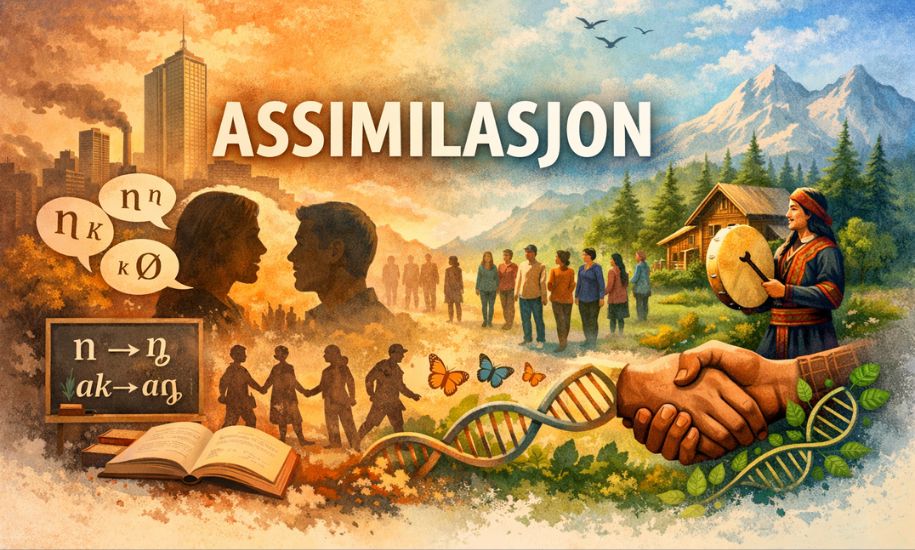
Assimilasjon is one of those ideas that feels abstract at first, yet it quietly touches almost everything we do. It influences how people speak, how communities evolve, how newcomers find their place, and how shared norms slowly take shape over time. The word itself simply points to a process of becoming more similar, but the reality behind it is layered, subtle, and often debated.
In daily conversations, assimilasjon is sometimes used casually, almost as a synonym for “fitting in.” In academic and professional contexts, it carries more weight. Linguists use it to describe how sounds shift when spoken together. Sociologists use it to describe how groups adapt within a larger population. Psychologists, biologists, and educators also rely on the concept to explain learning, adjustment, and growth.
What makes assimilasjon especially interesting is that it rarely happens all at once. It unfolds gradually, often unnoticed, shaped by habits, incentives, pressure, and time. Sometimes it feels natural and even helpful. Other times it raises concerns about loss, imbalance, or fairness. This balanced tension is exactly why the topic continues to attract attention across research, policy discussions, and everyday life.
In a space like Buz Vista, where broad trends and real-world implications matter, assimilasjon stands out as a topic that connects language, culture, and social dynamics in a way that feels both timeless and current.
The Core Meaning of Assimilasjon Across Fields
At its most basic level, assimilasjon describes a process where something becomes more like something else. That simple idea expands in different directions depending on the field using it.
In language, assimilasjon explains why spoken words often sound slightly different from how they are written. Human speech favors efficiency and flow. When sounds sit next to each other, they influence one another. Over time, these small shifts become standard pronunciation patterns rather than exceptions.
In social contexts, assimilasjon refers to how individuals or groups adjust to shared norms within a broader society. This may involve language use, social behavior, values, or public expectations. The process can be gradual and voluntary, or shaped by structural pressures such as education systems, labor markets, or legal frameworks.
In psychology and learning theory, assimilasjon describes how new information is absorbed into existing mental frameworks. Instead of completely reshaping beliefs, people often fit new ideas into what they already know, adjusting details rather than rebuilding from scratch.
In biology and physiology, assimilasjon can describe how organisms convert nutrients into body tissue or energy, again reflecting the theme of transformation and incorporation.
Across all these uses, a common pattern appears:
- There is an existing structure or system
- New elements enter that system
- Adjustment happens in a way that reduces difference over time
This shared pattern is why the concept remains useful across disciplines, even though the outcomes and implications vary widely.
Linguistic Assimilasjon: How Speech Quietly Adapts
Language offers one of the clearest and least controversial examples of assimilasjon at work. Most people practice linguistic assimilasjon every day without realizing it. It happens automatically, guided by ease of pronunciation rather than conscious choice.
When people speak quickly, certain sounds naturally influence their neighbors. A consonant may change slightly to match the place of articulation of the next sound. A vowel may shift to harmonize with surrounding vowels. These changes are not mistakes. They are efficiency mechanisms built into human speech.
Imagine a hypothetical word sequence where a nasal sound is followed by a hard consonant. Instead of clearly pronouncing both sounds in isolation, speakers often blend them, producing a smoother result. Over generations, these small adjustments can become fixed pronunciation rules within a language.
Linguistic assimilasjon generally falls into a few broad patterns:
- Regressive assimilation, where a sound is influenced by the sound that follows
- Progressive assimilation, where a sound is influenced by the sound that comes before
- Total assimilation, where sounds become nearly identical
- Partial assimilation, where only some features change
What makes this process fascinating is that it improves communication rather than harming it. Listeners rarely notice the shift, and meaning remains intact. In fact, speech often becomes easier to process because it aligns with natural expectations.
This form of assimilasjon is rarely emotional or political. It shows how adaptation can be neutral, functional, and even beneficial. That clarity helps explain why the same term is applied elsewhere, even when outcomes become more complex.
Social and Cultural Assimilasjon: Adaptation, Belonging, and Tension
When the conversation moves from sounds to societies, assimilasjon becomes more nuanced. Social and cultural assimilasjon describes how people adjust when they live within a shared system of norms, rules, and expectations.
Consider a hypothetical scenario. A person moves to a new country for work. At first, daily routines feel unfamiliar. Over time, small changes happen. Language choices shift. Social cues become easier to read. Workplace behavior adapts to local expectations. None of this requires abandoning identity, yet it reflects gradual alignment with the surrounding environment.
This is often how assimilasjon unfolds in practice. It is not a single decision, but a sequence of small adjustments shaped by incentives, comfort, and social feedback.
Still, the concept raises important questions. How much adaptation is reasonable to expect? At what point does encouragement turn into pressure? Where is the line between shared norms and loss of diversity?
These questions matter because assimilasjon does not happen in a vacuum. Power structures, institutional rules, and historical context influence who adapts and how much adaptation is expected. In many societies, dominant norms are treated as neutral, while minority practices are labeled as deviations. This imbalance shapes the experience of assimilasjon, even when intentions appear neutral.
Key factors that influence social assimilasjon include:
- Language requirements in education or employment
- Informal social expectations in public spaces
- Legal frameworks tied to citizenship or residency
- Economic incentives linked to conformity
A balanced view recognizes that some level of shared norms is necessary for coordination and trust, while excessive pressure to conform can weaken social cohesion rather than strengthen it. This tension is why assimilasjon remains a topic of ongoing debate rather than settled consensus.
Assimilasjon Versus Integration: A Common Source of Confusion
Assimilasjon is often discussed alongside integration, and the two are sometimes treated as interchangeable. They are related, but they point in slightly different directions.
Assimilasjon focuses on similarity. The process moves toward reducing visible or functional differences. Integration, by contrast, emphasizes participation without necessarily erasing difference. A person can be integrated into a society while still maintaining distinct cultural practices.
To clarify the distinction, imagine two hypothetical workplaces. In one, all employees are expected to adopt identical communication styles, social habits, and schedules. In the other, employees share common rules for collaboration but retain flexibility in expression and personal routines. Both environments function, but they rely on different assumptions.
This comparison highlights why discussions around assimilasjon often carry emotional weight. For some, assimilasjon represents opportunity and stability. For others, it feels like an uneven demand placed on those with less social power.
The difference becomes especially relevant in policy debates, where language choices shape expectations. Framing a goal as assimilation signals one set of priorities. Framing it as integration signals another. Neither approach is inherently right or wrong, but clarity matters.
Recognizing this distinction helps keep discussions grounded and reduces unnecessary conflict. It also allows space for more flexible solutions that balance shared standards with individual expression.
Practical Implications in Modern Life
Assimilasjon is not limited to theory. It shapes real-world decisions in education, work, media, and governance. These effects often appear in subtle ways rather than headline moments.
In schools, assimilasjon influences curriculum design, language instruction, and behavioral expectations. Students are taught shared standards, but the degree to which diversity is accommodated varies. Some systems prioritize uniform outcomes, while others emphasize pluralism within a shared framework.
In the workplace, assimilasjon appears in communication norms, leadership styles, and performance evaluation. Employees often adjust speech patterns, presentation styles, or even time management habits to align with organizational culture. These changes may improve collaboration, but they can also create pressure to suppress difference.
In media and public discourse, assimilasjon affects which stories are considered relatable and which voices are amplified. Representation choices send signals about what is seen as normal or peripheral.
Even in finance and business environments, assimilasjon plays a role. Organizations often expect newcomers to align with established processes, risk tolerance norms, and ethical standards. In investment discussions involving firms like Ashcroft Capital, for example, shared frameworks for evaluating risk and return allow collaboration across diverse backgrounds without requiring personal uniformity.
These examples show that assimilasjon is not inherently positive or negative. Its impact depends on context, scale, and flexibility. When adaptation flows in multiple directions, systems tend to feel resilient. When it flows only one way, friction increases.
Why Assimilasjon Remains a Search Topic People Return To
The continued interest in assimilasjon is not accidental. It reflects a broader curiosity about how people coexist in complex systems. Global mobility, digital communication, and cultural exchange have increased contact between different norms and practices. With that contact comes adjustment.
People searching for this topic are often looking for clarity rather than controversy. They want to know how adaptation works, where its limits lie, and what it means for identity, fairness, and cooperation. They are also looking for language to describe experiences that feel familiar but hard to name.
Assimilasjon offers that language. It provides a neutral framework for talking about change without assuming intent or assigning blame. That neutrality makes it useful across disciplines and discussions, from classrooms to boardrooms.
In platforms like Buz Vista, where readers value context and nuance, this concept resonates because it invites reflection rather than reaction. It encourages people to notice the slow processes shaping daily life, not just the loud moments that dominate headlines.
Key Takeaways That Bring It All Together
Assimilasjon is a quiet force, but it is not a small one. It explains how sounds shift in speech, how people adapt within societies, and how systems maintain coherence over time. It can feel natural or imposed, beneficial or uncomfortable, depending on how it unfolds.
The most important insight is balance. Assimilasjon works best when it allows room for mutual adjustment rather than one-sided conformity. Shared norms matter, but so does the space to remain distinct.
By viewing assimilasjon as a process rather than a verdict, it becomes easier to discuss without fear or defensiveness. It becomes a tool for observation rather than a label for judgment. That perspective keeps conversations productive and grounded, especially in a world where change is constant and difference is unavoidable.
Frequently Asked Questions (FAQs) About Assimilasjon
What does assimilasjon mean in simple terms?
Assimilasjon refers to a process where something gradually becomes more similar to something else. This can apply to language sounds, social behavior, learning patterns, or cultural norms. The key idea is adaptation over time, not instant change.
Is assimilasjon always intentional?
No. Assimilasjon often happens without conscious planning. In language, it occurs automatically as people speak. In social settings, individuals may adapt behaviors naturally to feel comfortable or to function smoothly in shared environments.
How is assimilasjon different from integration?
Assimilasjon focuses on reducing differences by adapting to existing norms, while integration emphasizes participation within a system without necessarily removing differences. Integration allows more visible diversity alongside shared rules.
Can assimilasjon be positive?
Yes. Assimilasjon can make communication easier, improve cooperation, and help systems function efficiently. In many cases, it supports social coordination and mutual understanding.
Can assimilasjon be harmful?
It can be, especially if adaptation is expected only from one group or enforced through pressure. When people feel they must abandon important aspects of identity to belong, assimilasjon may create stress or inequality.
Does assimilasjon mean losing identity?
Not necessarily. Many forms of assimilasjon involve surface-level adaptation, such as language use or social habits, while deeper values and identities remain intact. The outcome depends on context and expectations.
Where does assimilasjon appear most clearly in everyday life?
It shows up in speech patterns, workplace culture, school environments, and social interactions. People often adjust how they speak, dress, or behave based on shared expectations without explicitly labeling it as assimilasjon.
Is assimilasjon a fast or slow process?
Assimilasjon is usually gradual. Small adjustments accumulate over time, making the process feel natural rather than sudden. This slow pace is why it often goes unnoticed.
Why is assimilasjon still widely discussed today?
Global movement, digital communication, and cultural interaction have increased contact between different norms. Assimilasjon helps explain how people and systems adapt when differences meet.
Is assimilasjon the same in every society?
No. Social norms, laws, history, and power structures all influence how assimilasjon works. What feels natural in one society may feel restrictive in another.