

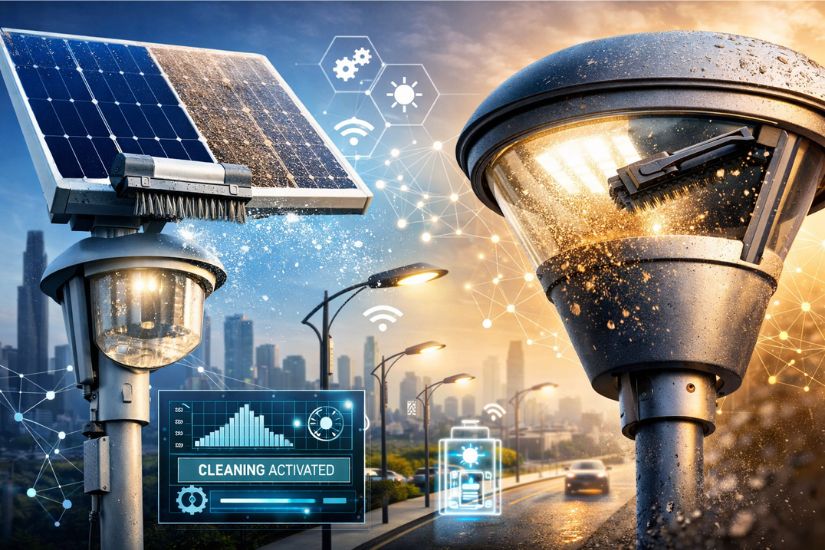
In modern urban planning, street lighting is no longer just about illumination. The focus has shifted toward efficiency, durability, and minimal maintenance, particularly in areas prone to dust, pollution, and harsh environmental conditions. One of the most promising developments in this field is the emergence of self-cleaning street lamps and dust-resistant lamp projects. These innovations are reshaping how cities maintain public lighting while reducing costs and energy waste. In this article, we explore the research, existing projects, and future of these intelligent lighting systems, with insights from Buz Vista.
Why Self-Cleaning Street Lamps Are Needed
Traditional street lamps often suffer from dust accumulation, pollution, and environmental wear, leading to decreased light efficiency and higher maintenance costs. In regions with deserts, construction zones, or heavy traffic pollution, dust buildup on lamp covers and solar panels can reduce light output by 30–50%.
Self-cleaning street lamps aim to solve these challenges by incorporating:
- Dust-resistant coatings
- Automated cleaning mechanisms
- Smart sensors for performance monitoring
These features not only improve lighting efficiency but also reduce the frequency of manual cleaning, saving municipalities time and money.
How Self-Cleaning Street Lamps Work
1. Advanced Surface Technology
One of the key innovations in dust-resistant lamps is the use of hydrophobic and oleophobic nano-coatings. These coatings prevent dust and other particles from sticking to lamp surfaces or solar panels. Materials such as nano-silica and titanium dioxide are commonly used to achieve this effect.
In addition, anti-static polymer films can reduce the electrostatic attraction that normally causes dust to cling, allowing natural rain or minimal cleaning forces to keep the lamps clean.
2. Mechanical Cleaning Systems
Many projects incorporate mechanical cleaning mechanisms to remove dust automatically. These include:
- Brushes or wipers: Sweep dust off lamp covers and solar panels.
- Vibration systems: Shake dust loose without damaging the lamp.
- Robotic cleaning arms: Triggered by sensors when light efficiency drops.
These systems often work autonomously, using embedded sensors to detect when cleaning is needed, ensuring optimal light output at all times.
3. Sensor Integration and Smart Monitoring
Modern self-cleaning lamps can be connected to smart city networks. Optical sensors measure light output, and when it drops below a set threshold due to dust or dirt, the cleaning mechanism activates automatically. Some systems even provide real-time monitoring via mobile apps or control centers, allowing city engineers to track lamp health and schedule maintenance more efficiently.
Existing Research and Projects
Patents and Innovations
Several patents showcase the real-world progress of self-cleaning street lamps:
- CN112845219A – Features brushes, rainwater storage, and automated cleaning mechanisms for LED street lamps.
- CN210860857U – Focuses on utility design for integrated self-cleaning functionality.
- CN108916749A and CN111520658B – Demonstrate continued innovation in dust-removal and cleaning techniques.
These patents highlight that self-cleaning street lamps are not just theoretical concepts, but actively researched and protected intellectual property.
Commercial Deployments
Manufacturers are developing solar-powered self-cleaning street lights, particularly for desert or high-pollution areas. These lamps combine timed cleaning brushes with energy-efficient solar panels, ensuring that cleaning operations do not drain the lamp’s primary energy source. Such deployments are increasing in smart city pilot projects globally.
Benefits of Dust-Resistant Street Lamps
- Reduced maintenance costs – Less frequent manual cleaning.
- Consistent lighting efficiency – Dust-free surfaces maintain brightness.
- Extended lifespan of lamps – Reduced wear from dirt accumulation.
- Energy efficiency – Solar panels perform better without dust blockage.
- Smart city integration – Can be connected to urban monitoring systems.
Challenges and Limitations
Despite their promise, these systems face certain challenges:
- Higher upfront costs – Self-cleaning lamps are more expensive than conventional lights.
- Mechanical wear – Cleaning parts may require periodic replacement.
- Environmental limitations – Effectiveness varies depending on local dust and weather conditions.
- Energy consumption – Automated cleaning must be balanced against energy savings.
Future Outlook
Research indicates that self-cleaning and dust-resistant street lamps are still emerging technologies. While pilot projects have been successfully implemented, widespread adoption is limited by costs and environmental variability. However, advances in materials science, robotics, and smart sensors are likely to make these systems more affordable and practical for cities worldwide.
Experts predict that within the next decade, self-cleaning street lamps could become a standard feature of smart, low-maintenance urban infrastructure, especially in cities aiming to reduce operational costs and environmental impact.
Conclusion
Self-cleaning street lamps represent a significant step forward in urban lighting technology, combining dust-resistant materials, mechanical cleaning systems, and smart monitoring. Projects and patents around the world confirm that these systems are not just futuristic ideas—they already exist and are being tested in real-world conditions.
For more insights on the latest technology and smart city innovations, visit Buz Vista, where we track emerging trends and research in sustainable urban development.