

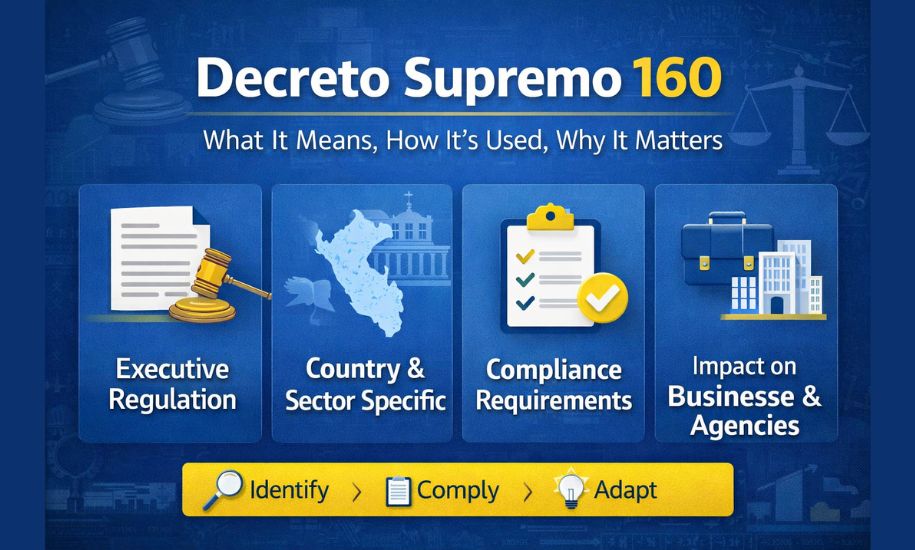
Supreme Decree 160 is a legal instrument of significant relevance in the functioning of the Peruvian state and the administration of public resources, particularly regarding budgetary management and governance. In Peru’s current legal and social context—where efficient public spending and transparency in state administration are priorities—Supreme Decree 160 serves as a key mechanism for authorizing transfers of budgetary allocations in favor of specific entities. Understanding its content and application is essential not only to assess its impact on public administration but also to ensure alignment with constitutional principles such as legality, efficiency, and fiscal responsibility.
The decree has been used in recent fiscal exercises to authorize budget reallocations to entities such as the Peruvian Marine Institute and the National Institute of Quality, enabling resource allocation for projects and activities aligned with government priorities. Its practical role in Peru’s public contracting and resource management underscores the importance of legal compliance and accountability in public administration.
General Framework of Supreme Decree 160
In Peruvian law, a supreme decree is a regulatory instrument issued by the Executive Branch under constitutional authority, designed to develop, clarify, or execute laws and public policies. Supreme Decree 160 falls into this category and, in its most recent version, authorizes transfers of budget allocations within the public sector for the fiscal year in question.
In essence, the decree empowers public entities to reallocate financial resources within their approved budget under strict technical and legal criteria, ensuring that public policies and sector priorities are funded efficiently.
Key Provisions and Implications
1. Authorization of Budget Transfers
The central provision of Supreme Decree 160 is the authorization of transfers of budgetary allocations between different areas of an institution’s budget. In its latest version for the 2024 fiscal year, the decree authorizes such transfers for entities including the Peruvian Marine Institute and the National Institute of Quality.
Practical implications include:
- Flexibility in public spending: Entities can adjust their budget allocations to respond to urgent or unforeseen needs.
- Efficient project execution: Reallocating funds ensures that priority programs or projects continue without waiting for congressional approval of a new budget.
- Fiscal responsibility: While offering flexibility, it requires a balance to prevent misallocation or deviation from the approved spending plan.
2. Technical and Legal Requirements
Supreme Decree 160 does not authorize arbitrary budget transfers. Each transfer requires a technical report prepared by the entity’s budget and planning units and must comply with national budget law and regulations. This ensures adherence to legal compliance and accountability principles.
Moreover, the transfers must be used strictly for the approved purpose, demanding rigorous monitoring, evaluation, and reporting.
Comparison with Previous Legislation
Historically, similar decrees have been used in prior fiscal years to authorize budget reallocations or supplementary credits. However, Supreme Decree 160 of 2024 demonstrates notable differences and improvements:
- Specificity of beneficiaries: The decree clearly identifies recipient entities, ensuring funds align with targeted public priorities.
- Enhanced regulatory context: Recent versions incorporate updated MEF directives and budget system regulations to strengthen technical controls and evaluation procedures.
- Transparency and accountability: Compared to earlier decrees, the 2024 decree includes stricter requirements for public reporting and monitoring, reflecting a trend toward government transparency law compliance and responsible governance.
These changes illustrate the Peruvian government’s commitment to enhancing public financial administration while promoting accountability and efficiency.
Relevance in the Current Legal and Policy Framework
Supreme Decree 160 operates within a broader context of fiscal reforms and public policy in Peru. The government has faced challenges such as responding to emergencies, implementing social programs, and achieving economic development targets while maintaining fiscal discipline.
The decree aligns with the principles established in the General Law of the National Budget System and Peru’s constitutional requirements, ensuring that approved transfers do not compromise fiscal balance or misuse public resources.
Its timely use is especially relevant in situations requiring rapid execution of expenditure, such as emergency responses or urgent government initiatives, demonstrating how legal compliance and efficient administration intersect.
Criticisms, Controversies, and Public Debate
Although technical in nature, Supreme Decree 160 has generated debate in Peru:
1. Risk of Reduced Transparency
One criticism is that budget transfers authorized through a supreme decree may reduce transparency if not accompanied by clear reporting mechanisms. Without public disclosure, these transfers can be perceived as discretionary executive actions lacking adequate oversight.
2. Legislative Oversight Debate
There is also debate over the role of Congress in monitoring public budgets. While the Constitution grants Congress authority to approve the annual budget, executive decrees like DS 160 raise questions about balancing administrative efficiency and parliamentary control.
3. Socio-Economic Implications
Critics warn that reallocating funds without detailed prior planning may adversely affect certain sectors originally allocated resources, potentially prioritizing politically motivated projects over technically justified ones. This raises ethical considerations in resource management.
Impact on Businesses, Citizens, and Institutions
1. Businesses and the Private Sector
Supreme Decree 160 indirectly affects private entities engaged with the government:
- Public contracting: Changes in budget allocations may impact available funds for procurement and contracts, affecting project planning for private firms.
- Compliance and transparency: Companies involved in Peru public contracting must stay informed about budget transfers to ensure compliance and operational continuity.
2. Citizens and Civil Society
For citizens and civil society organizations, the decree is a critical point for monitoring government accountability:
- Access to information: Transfers must be transparent to enable oversight and ensure public resources achieve intended social outcomes.
- Trust in governance: Proper documentation and justification of transfers strengthen confidence in public administration and government transparency law compliance.
3. Public Officials and Administrative Bodies
For government officials, Supreme Decree 160 is a tool requiring adherence to high standards of legal compliance:
- Preparation of detailed technical reports to justify transfers.
- Ensuring execution aligns with intended objectives.
- Implementing monitoring and evaluation mechanisms to track outcomes.
Technical Compliance and Ethical Considerations
Supreme Decree 160 imposes strict obligations on technical units and authorities:
- Technical justification: Transfers must respond to objectively identified needs with clear policy rationale.
- Publication and transparency: Administrative acts linked to the transfers should be publicly accessible to promote ethical governance.
- Outcome evaluation: Beyond authorization, results must be evaluated to link expenditure to tangible public benefits.
Conclusion
Supreme Decree 160 is a highly significant legal instrument within Peru’s public budgeting and administrative framework. Its relevance lies in authorizing budget transfers while balancing flexibility with fiscal responsibility.
This analysis demonstrates the decree’s role within broader reforms, its impact on multiple stakeholders—citizens, businesses, and public institutions—and the ongoing debates surrounding transparency and legislative oversight. Effective use of such decrees requires accountability mechanisms, result-based evaluation, and active citizen participation to strengthen trust, uphold legal compliance, and enhance government transparency.
Understanding Supreme Decree 160 is therefore essential for all stakeholders involved in public administration, legal compliance, or Peru public contracting, ensuring that public resources are used efficiently, transparently, and ethically.