

Introduction
Living organisms have evolved a wide range of survival strategies to protect themselves from predators, competitors, and environmental threats. One of the most intriguing among these strategies is kleptotoxicity—a biological phenomenon in which organisms acquire toxic chemicals from other species and repurpose them for their own defense.
Unlike organisms that synthesize toxins internally, kleptotoxic species rely on ecological interactions and dietary sources to obtain chemical defenses. This process highlights the deep connection between evolution, ecology, chemistry, and the scientific practices used to understand life itself.
Kleptotoxicity has been studied through careful observation, controlled experiments, chemical analysis, and evolutionary theory, making it an excellent example of how modern biological science operates.
What Is Kleptotoxicity? (Scientific Definition)
Kleptotoxicity is the biological process by which an organism sequesters toxic compounds from another organism—typically through feeding—and retains those compounds for defensive or ecological advantage.
The term is derived from:
- Klepto (Greek: “to steal”)
- Toxicity (the ability of a substance to cause harm)
From a scientific perspective, kleptotoxicity is a form of chemical defense acquisition, distinct from toxin biosynthesis. It is closely related to concepts such as toxin sequestration, chemical ecology, and adaptive evolution.
Historical Discovery and Scientific Observation
The idea of kleptotoxicity emerged through systematic observation, one of the core practices of science.
Early naturalists noticed that:
- Some animals were toxic despite lacking toxin-producing glands
- Toxicity disappeared when these animals were raised on different diets
- Predators avoided certain species after negative experiences
These observations led scientists to hypothesize that toxins were diet-derived, not internally produced. This hypothesis was later confirmed through chemical analysis and experimental feeding studies.
Mechanisms of Kleptotoxicity
Kleptotoxicity operates through a series of well-studied biological mechanisms:
1. Dietary Intake
The organism consumes plants, insects, or animals that produce toxic compounds as a primary defense.
2. Physiological Resistance
Kleptotoxic species evolve molecular adaptations—such as modified ion channels, enzymes, or receptors—that prevent toxins from harming their own cells.
3. Sequestration and Storage
Toxins are transported and stored in specific tissues such as:
- Skin
- Glands
- Feathers
- Fat deposits
4. Defensive Deployment
When threatened, toxins deter predators through:
- Bad taste
- Nerve disruption
- Skin irritation
- Toxic poisoning
These mechanisms have been confirmed using laboratory experiments, biochemical assays, and comparative anatomy, all standard scientific practices.
Key Examples of Kleptotoxicity in Nature
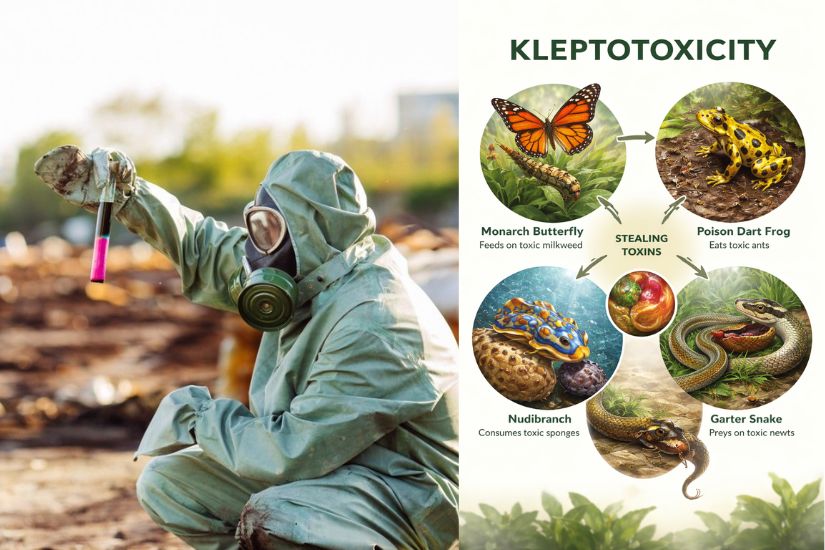
Monarch Butterflies (Danaus plexippus)
Monarch caterpillars feed on milkweed plants containing cardenolides, toxic steroid compounds. These toxins are retained through metamorphosis and remain active in adult butterflies.
Scientific significance:
- Demonstrates toxin retention across life stages
- Studied through predator-feeding experiments with birds
- Supports evolutionary warning coloration (aposematism)
Poison Dart Frogs (Family: Dendrobatidae)
These frogs acquire alkaloid toxins from ants and mites in their diet. Frogs raised in captivity without these insects are non-toxic.
Scientific evidence:
- Controlled feeding experiments
- Chemical comparison of wild vs captive frogs
- Strong support for dietary toxin acquisition
Sea Slugs (Nudibranchs)
Many nudibranchs feed on toxic sponges or cnidarians and store the toxins in their tissues. Some species even steal functional nematocysts (stinging cells).
Scientific importance:
- Example of extreme chemical and cellular theft
- Studied using microscopy and chemical profiling
- Bridges biology and marine chemistry
Pitohui Birds
These birds contain batrachotoxin, one of the most potent natural neurotoxins. The toxin is believed to come from beetles consumed in their diet.
Scientific approach used:
- Field sampling
- Toxicological testing
- Comparative dietary analysis
Garter Snakes and Toxic Newts
Certain garter snakes consume tetrodotoxin-rich newts and retain the toxin in their bodies.
Evolutionary insight:
- Demonstrates coevolution
- Studied through genetic resistance analysis
- Shows predator-prey arms races
Kleptotoxicity and Evolutionary Biology
From an evolutionary standpoint, kleptotoxicity offers several adaptive advantages:
- Energy conservation: No need to synthesize complex toxins
- Rapid adaptation: Toxicity changes with diet
- Enhanced survival: Strong deterrence against predators
Natural selection favors individuals that can tolerate and store toxins, leading to genetic traits that spread across populations.
This evolutionary process is supported by:
- Comparative studies
- Phylogenetic analysis
- Population genetics
Ecological Role of Kleptotoxicity
Kleptotoxicity influences ecosystems at multiple levels:
Predator–Prey Interactions
Predators learn to avoid toxic species, reshaping feeding behavior and food webs.
Chemical Transfer in Ecosystems
Toxins move across trophic levels, affecting organisms beyond the original producer.
Biodiversity Maintenance
Chemical defenses allow species to occupy ecological niches that would otherwise be inaccessible.
Practices of Science in Studying Kleptotoxicity
Kleptotoxicity is a textbook example of how science works:
Observation
Scientists observe toxic traits and predator avoidance behaviors.
Hypothesis Formation
Researchers hypothesize dietary toxin acquisition.
Experimentation
Controlled feeding experiments test toxicity changes.
Data Analysis
Chemical assays identify and quantify toxins.
Peer Review
Findings are published, reviewed, and replicated.
This systematic process ensures scientific reliability and separates evidence-based knowledge from speculation.
Distinction from Related Concepts
| Concept | Difference |
|---|---|
| Autotoxicity | Toxins produced internally |
| Bioaccumulation | Passive buildup without adaptive use |
| Kleptoplasty | Stealing chloroplasts, not toxins |
Kleptotoxicity is unique because it involves active evolutionary use of stolen toxins.
Human and Scientific Relevance
Understanding kleptotoxicity contributes to:
- Drug discovery and toxicology
- Evolutionary theory
- Conservation biology
- Environmental risk assessment
By studying how organisms safely manage toxins, scientists gain insight into resistance mechanisms that may inspire medical and technological applications.
Conclusion
Kleptotoxicity reveals that survival in nature is not only about strength or speed, but also about strategy. By stealing and repurposing chemical defenses, organisms exploit existing biological systems to their advantage.
Through careful scientific observation, experimentation, and analysis, kleptotoxicity has become a powerful example of how ecology, evolution, and chemistry intersect. It reminds us that nature often solves complex problems using efficient, unexpected pathways—insights that continue to shape modern biological science.
You May Also Read About: Bjudlunch
You May Also Read About:Tomazen