

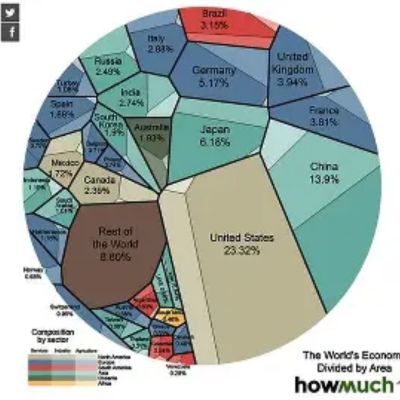
When people talk about a “slice of the economy,” they are usually trying to make a very big, complex system easier to understand. The economy as a whole includes everything from factories and farms to online services, housing, healthcare, and financial markets. That’s overwhelming to think about all at once. So instead, we break it into slices.
A slice of the economy refers to a portion, sector, or share of overall economic activity. That slice might be defined by industry, type of work, source of income, or even by who benefits from it. The phrase is popular because it works at many levels. You can use it to explain national trends, business growth, employment patterns, or even personal income opportunities.
In simple terms, the economy is like a large pie. No single group or activity owns the entire pie. Instead, different groups receive different slices, and those slices can grow, shrink, or change shape over time.
Understanding how these slices are formed and measured helps people make better decisions, whether they are business owners, workers, investors, or policymakers.
What a “Slice of the Economy” Represents
A practical way to divide something complex
At its core, a slice of the economy represents a defined portion of economic activity. That portion can be based on many factors, such as:
- An industry (technology, manufacturing, agriculture)
- A type of activity (services, production, investment)
- A group of participants (small businesses, households, exporters)
- A source of income (wages, profits, rents)
The phrase works because it is flexible. It allows someone to focus on one part of the system without pretending that part exists in isolation.
For example, when someone says, “Small businesses make up a significant slice of the economy,” they are not claiming small businesses are the entire economy. They are highlighting their role relative to other contributors.
Why economists and writers use this phrase
Economists often rely on data categories like output, employment, or income. The phrase “slice of the economy” helps translate those categories into everyday language.
Instead of saying, “This sector accounts for a certain percentage of gross output,” someone might say, “This sector represents a growing slice of the economy.” The meaning is the same, but the second version is easier to grasp.
This phrasing also allows for comparison. You can talk about:
- A growing slice versus a shrinking slice
- A large slice that is stable
- A small slice that is expanding quickly
Each of these tells a different story about economic change.
Not all slices are equal
One important point is that slices of the economy are not evenly sized, and they don’t always grow at the same pace.
Some slices are large but slow-moving. Others are small but dynamic. A small slice today can become much larger over time if demand increases or technology changes how that activity is performed.
This is why focusing only on size can be misleading. Growth rate, influence, and future potential also matter.
How Slices of the Economy Are Defined and Measured
Common ways slices are measured
There is no single way to define a slice of the economy. Measurement depends on the question being asked. Common approaches include:
- Share of total output: How much value a sector produces compared to the whole economy
- Employment share: How many people work in that area
- Income share: How much income flows to workers or owners in that slice
- Investment share: How much capital is being directed there
Each method highlights something different.
For example, a sector may employ many people but generate lower output per worker. Another sector may employ fewer people but generate high profits.
Both are valid slices, just viewed through different lenses.
Sector-based slices
One of the most familiar ways to talk about slices of the economy is by sector.
Broadly, these include:
- Production-oriented activities
- Service-based activities
- Knowledge and technology-driven activities
Each sector contains many smaller sub-slices. Services alone can include healthcare, education, logistics, hospitality, and professional work. Talking about slices helps avoid lumping everything together.
Income-based slices
Another powerful use of the term focuses on who receives what portion of economic value.
In this context, a slice of the economy might describe:
- The share of income going to workers
- The share going to business owners
- The share captured through rents or investments
This framing is often used when discussing fairness, opportunity, and long-term stability. If one group’s slice grows rapidly while others stagnate, social and economic tensions can emerge.
Why measurements don’t always agree
It’s common to see different statistics that seem to contradict each other. One report might say a sector is booming, while another suggests it’s shrinking.
This usually happens because they are measuring different slices in different ways.
For example:
- Output might be rising
- Employment might be falling
- Profits might be increasing
All three can be true at the same time.
Understanding what slice is being measured prevents confusion and helps readers interpret economic claims more accurately.
Why Some Small Slices Matter More Than Their Size
Size versus influence
A common misconception is that only the largest slices of the economy matter. In reality, influence is not always proportional to size.
A small slice can:
- Drive innovation
- Influence other sectors
- Shape future growth
Think of it like a small component inside a machine. Even if it’s physically small, the entire system may depend on it functioning well.
Growth momentum and spillover effects
Some slices punch above their weight because they create spillover effects.
For example, a growing slice focused on advanced systems or efficiency improvements might:
- Reduce costs across other sectors
- Increase productivity
- Create new types of jobs
Even if that slice remains relatively small in terms of employment, its impact can ripple outward.
Investment-focused slices
Certain slices of the economy attract attention not because of their current size, but because of how much investment flows into them.
Investment signals expectations about the future. When capital concentrates in a specific area, it often leads to:
- New infrastructure
- Skill development
- Long-term structural change
This is why financial analysts and large firms, including organizations such as Ashcroft Capital, often look beyond current size and focus on trajectory.
The danger of ignoring small slices
Ignoring smaller slices can lead to missed opportunities or delayed responses.
Historically, many major economic shifts started in niches that were initially overlooked. By the time they became “large,” the adjustment costs were higher for those who failed to adapt.
Understanding the role of small but fast-growing slices helps individuals and institutions stay prepared.
How Slices of the Economy Affect Everyday Life
Employment and career choices
For individuals, slices of the economy are not abstract concepts. They directly affect job availability, wages, and career stability.
When a slice expands:
- New roles emerge
- Skill demand increases
- Wages may rise
When a slice contracts:
- Job competition intensifies
- Workers may need to retrain
- Entire career paths can shift
Understanding which slices are growing or shrinking helps people make informed decisions about education and work.
Consumer experience and pricing
Slices of the economy also influence what people pay for goods and services.
If a specific slice faces higher costs or lower productivity, consumers often feel it through:
- Higher prices
- Reduced availability
- Lower service quality
On the other hand, when efficiency improves in a slice, savings can be passed on to consumers.
Regional and local effects
Not all slices are evenly distributed across regions.
Some areas depend heavily on a single slice of the economy. When that slice thrives, the local economy grows. When it struggles, the impact can be severe.
This is why diversification matters. Regions tied too closely to one slice may experience sharper ups and downs than more balanced economies.
Policy and public decisions
Governments often design policies around specific slices of the economy, such as housing, energy, or employment.
Understanding slices helps citizens evaluate whether policies:
- Target growth-oriented areas
- Support vulnerable segments
- Balance short-term relief with long-term stability
Clear thinking about slices encourages more informed public discussion.
How the Idea of Economic “Slices” Is Evolving
Blurred boundaries between slices
In the past, slices of the economy were easier to define. Today, boundaries are less clear.
Many activities now overlap:
- Services rely on technology
- Production includes data and automation
- Work blends physical and digital elements
This makes traditional categories less precise, but the idea of slices remains useful as a conceptual tool.
Shifts toward intangible value
More economic value now comes from things that are hard to see or touch, such as knowledge, systems, and processes.
These intangible slices often:
- Require fewer physical resources
- Scale quickly
- Depend heavily on skills and organization
They may not employ as many people directly, but their influence can be wide.
Rebalancing and redistribution debates
As slices change, debates naturally follow about who benefits and who is left behind.
Discussions about fairness often revolve around:
- Whether income slices are balanced
- Whether opportunities are accessible
- Whether growth benefits are widely shared
These conversations are not just economic; they are social and cultural as well.
Why the concept still matters
Even as the economy becomes more complex, the idea of a slice of the economy remains relevant because it helps people:
- Break down complexity
- Compare different activities
- Understand change over time
At Buz Vista, this kind of framing is especially useful for readers who want clarity without oversimplification.
Soft Conclusion: Seeing the Economy One Slice at a Time
The economy is too large and interconnected to understand all at once. That’s why the idea of a “slice of the economy” is so valuable. It allows us to zoom in, examine one part carefully, and then zoom back out to see how it fits into the whole.
Whether we are talking about industries, income distribution, employment, or future growth, slices help tell stories that raw numbers alone cannot. They remind us that size is only one dimension, and that influence, growth, and impact matter just as much.
By thinking in slices, individuals can make better career choices, businesses can plan more strategically, and communities can better understand the forces shaping their future. In a constantly changing economic landscape, this simple concept remains one of the most effective tools for making sense of complexity.
FAQs
What does “slice of the economy” mean in simple terms?
A slice of the economy refers to a specific part or share of overall economic activity. This could be an industry, a type of work, a group of earners, or a source of income within the larger economy.
Is a slice of the economy the same as a sector?
Not exactly. A sector is a formal classification, while a slice of the economy is a broader, more flexible idea. A slice can include multiple sectors or be defined by income, employment, or investment rather than industry alone.
Can a small slice of the economy still be important?
Yes. A slice does not need to be large to matter. Some small slices influence productivity, innovation, or long-term growth far more than their size suggests.
How is a slice of the economy measured?
It can be measured in several ways, including share of total output, number of jobs, income generated, or amount of investment flowing into that activity. The method depends on what is being analyzed.
Why do economists use the phrase “slice of the economy”?
The phrase makes complex economic data easier to understand. It helps explain which parts of the economy are growing, shrinking, or changing without using overly technical language.
Does every country have the same economic slices?
No. Each country’s economy is shaped by its resources, workforce, policies, and history. As a result, the size and importance of different slices vary widely between countries.
How do slices of the economy affect everyday people?
They influence job availability, wage growth, prices, and long-term career opportunities. Changes in one slice can affect many others, eventually reaching households and consumers.
Can slices of the economy change over time?
Yes. Slices constantly shift as technology evolves, consumer demand changes, and new forms of work emerge. What is a small slice today may become much larger in the future.
Why do people talk about income as a slice of the economy?
Income-based slices show how economic value is distributed. They help explain how much of total economic output goes to workers, business owners, or investors.
Is focusing on one slice of the economy risky?
It can be. Overreliance on a single slice may create vulnerability if that area slows down. Balanced growth across multiple slices usually leads to greater economic stability.